
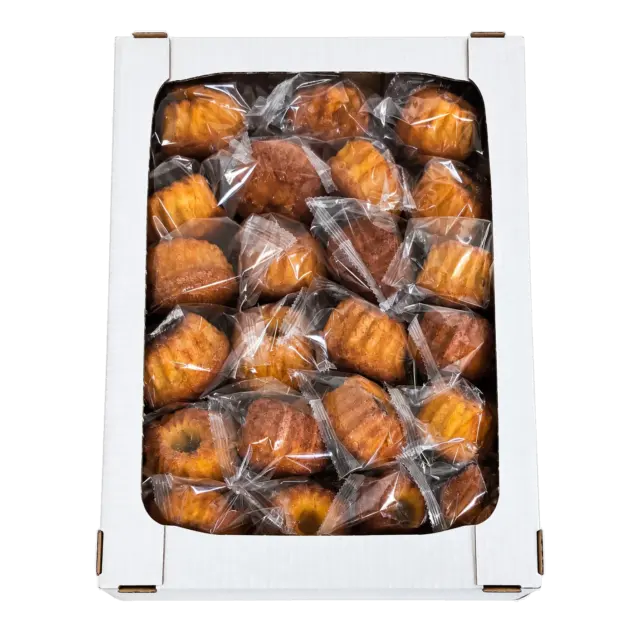
Our decision to replace palm fat (the same thing as “palm oil”, not to be confused with “palm kernel oil”) in our toffee-based sweets with coconut oil and sunflower oil earned a lot of approval from customers, and also a few questions. I tried to answer them on social media, but felt myself that replies in comment format were not exhaustive. So what is the deal with palm oil, really?
Why does the food industry use palm oil?
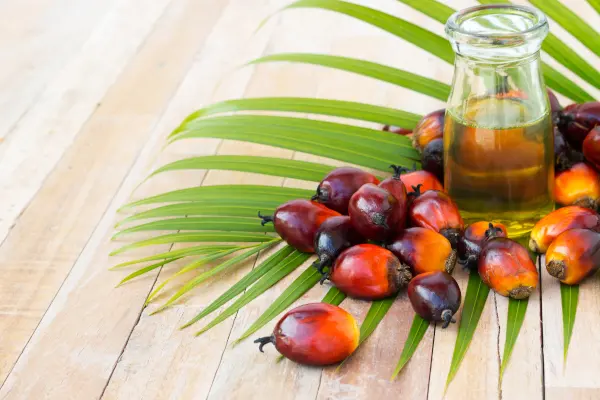
Palm oil is a vegetable fat with a structure well suited to the food industry: it is semi-solid (spreadable) at room temperature. It gives baked goods a pleasant texture, is almost odourless and tasteless, and is a fairly inexpensive vegetable fat. Typically palm oil is not added to baked goods as a separate raw material; rather, it is the main ingredient of margarines. Margarine, as we know, is the closest alternative to butter in terms of consistency. Besides being about 5.5 times cheaper than butter, margarine is very bake-stable and resistant to rancidity (the phenomenon of a baked product acquiring an “old” taste in storage). While products baked with butter go rancid in 1–3 months, margarine allows products that keep for a long time at room temperature.
Why does palm oil generate so much negative controversy?
The reason lies in how palm oil is produced and processed. Palm oil is grown on a relatively very small area of land: 90% of the world’s palm oil comes from either Indonesia or Malaysia. A glance at a population map shows these are already very densely populated regions. A glance at a natural resources map makes clear that this archipelago holds a considerable share of the planet’s rainforest reserves. The oil palm grows naturally in the rainforest, and clearing rainforest to establish palm oil plantations is depleting rainforest reserves at a rapid pace. Most people have heard that rainforests are the “lungs of the planet” because they produce a lot of oxygen. The other side of the coin is just as grim: per unit area, rainforests bind an enormous amount of carbon, which is released into the atmosphere as carbon dioxide when the forest is destroyed. The palm oil industry’s wastewater ponds, meanwhile, emit very large quantities of methane, a far more potent greenhouse gas. In short: land for oil palm plantations is taken at the expense of rainforest.
The controversial RSPO palm oil
To demonstrate that the environmental concerns described above have been resolved, interest groups created the producer responsibility organisation RSPO (Roundtable on Sustainable Palm Oil), which issues what is claimed to be one of the world’s strictest food-related compliance certificates for responsibly produced palm oil. Certified palm oil is labelled with either an SG (segregated) or MB (mass balance) certificate. The first means that responsibly produced palm oil is kept separate from other batches along the entire supply chain. With mass balance palm fat, certified and uncertified palm oil are sold side by side and accountability applies only to the aggregate quantities (a market participant may sell as much RSPO palm oil as it has bought/produced). In Estonia, RSPO-certified palm oil is 50–100% more expensive than ordinary palm oil.
So what exactly is the controversy with certified palm oil? As noted earlier, 90% of palm oil production is concentrated in Malaysia and Indonesia. In other words, the RSPO is an association consisting mainly of producers and wholesalers from these two countries – a well-concentrated, well-defined interest group. To add a few numbers: RSPO-certified palm fat makes up about 20% of the world’s total palm fat output, but as several recent scientific studies show, the environmental footprint of RSPO palm oil is not significantly smaller than that of ordinary palm oil. As the topic is sensitive and one of the key arguments of this article, I am adding references to several sources:
Total growth in land use of RSPO vs conventional palm oil plantations.
The land-use efficiency of RSPO palm oil production is no higher than that of conventional palm fat.
Greenpeace has conducted a thorough study of the RSPO organisation and its criteria in general.
EIA report on RSPO certification bodies.
In short: there is weighty evidence that the RSPO certificate does not solve the environmental problems associated with palm oil, and that it functions at least partly as a pretext for charging a higher price for palm oil and for erecting barriers to market entry.
But what about the environmental footprint of alternative vegetable oils?
Ragnar asked us this good question on Facebook, and the answer will inevitably contain a degree of subjectivity. Humans living on the planet and cultivating land for their needs is always harmful to the ecosystem to some extent. The coconut oil and sunflower oil we use to replace palm oil also have an environmental footprint. Advocates of mass palm oil production like to cite the oil palm’s high yield per hectare as an indicator of efficient production. The table shows Greenpalm data.
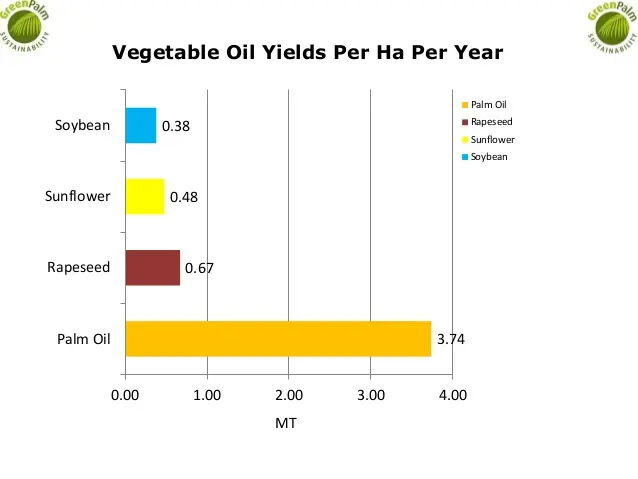
Looking purely at the numbers, the difference is impressive. Palm oil’s yield per hectare is 5–10 times higher than that of the other oils used as alternatives. However, I have two problems with these figures:
First: in my view such a comparison is not fair, because in the tropical rainforest zone all crops grow much faster. The areas where oil palms are grown are so fertile that they could produce two or more harvests a year of other crops as well (multicropping).
Second: a unit of tropical rainforest is far more valuable to the ecosystem as a whole than the same amount of land elsewhere. In the warmer temperate zone where sunflowers are grown, for example, the amount of arable land is not a problem. Very tellingly, the world’s two largest producers of sunflower oil are Russia and Ukraine. The palmoilinterconnections.com map showing palm oil cultivation by region could be summed up in one word: “rainforests”.
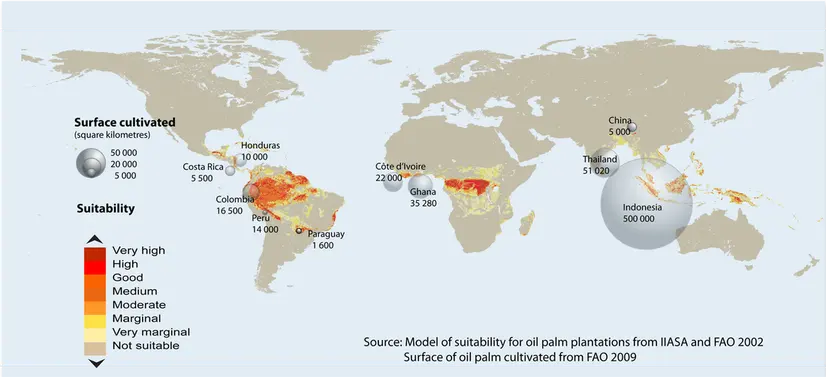
So to a large extent the question is not how much land is turned into fields, but rather where it is done. On the other hand, it is undeniably efficient production per unit of area – there is no arguing with that.
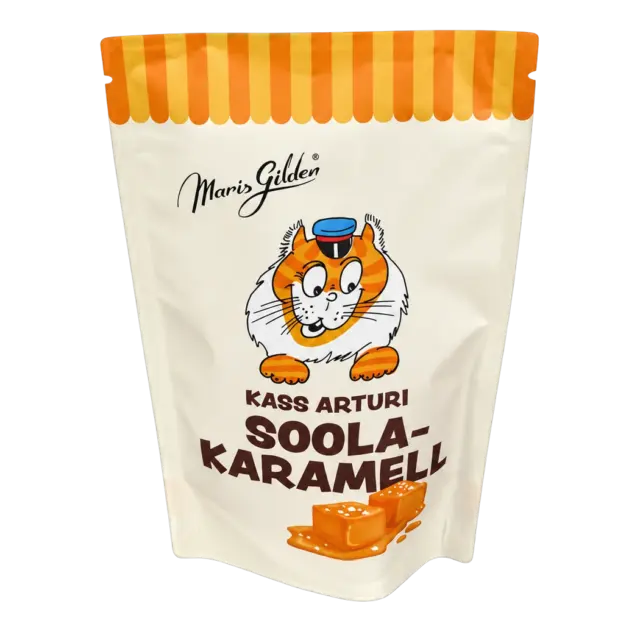
Why did we decide to remove palm fats from Maris Gilden AS sweets?
As with complicated questions in general, the answer consists of several arguments, some weightier than others.
- The replacement has a much cleaner and nicer ingredient list. Judge for yourself:
Former composition: margarine (vegetable oils and fats: rapeseed, palm, coconut; water, emulsifiers: mono- and diglycerides of fatty acids; acidity regulator: citric acid; flavouring; colour: beta-carotene, preservative: potassium sorbate)
New composition: coconut oil, sunflower oil, water.
- In our view the RSPO certificate is not a very convincing argument for palm oil. A survey among ordinary consumers shows that ordinary palm fat and RSPO palm fat enjoy almost the same (dis)favour.
- The mouthfeel of the coconut oil and sunflower oil combination is a little more pleasant and creamier than palm fat.
What about our other products where palm fat can still be found?
We do our best to take the market’s wishes into account. Where reasonably possible, we replace palm oil with another fat. If scientific research starts to prove/favour something else, we will try to move in that direction too. In some cases the change will not be quick, for technological or economic reasons. There is a very price-sensitive customer segment, and we have to take them into account as well. Keep an eye on our social media – we will certainly let you know when something new happens in this area! You can also get in touch at any time via the contact form.